Dev Diary # 2 - The Units on the Battlefield
by Davide Gambina
Decisive Campaigns: Twilight in the East scenario designer

Official main artwork for Decisive Campaigns: Twilight in the East.
From the beginning the goal of Decisive Campaigns: Twilight in the East was to recreate the historical and realistic experience of the fighting on the Eastern Front during World War II. Let's start by talking about the units you'll find on the battlefield from both the Wehrmacht and Red Army that you'll have to manage by moving, attacking, or defending your front line. Although some units are represented at the company or regiment level, the main building block of the units deployed on the battlefield is the battalion.
The Soviet Rifle Division
The rifle division that entered the war in June 1941 was, on paper, a sizable formation. It numbered 13.662 men and 792 officers with 84 50mm, 54 82mm and 12 120mm mortars plus 54 45mm AT guns. A strong unit, though it was often commanded by a young, inexperienced colonel, due to "Stalin's Purges" of the preceding years, which removed 154 of 186 division commanders but also 50 of 57 corps and 13 of 15 army commanders.
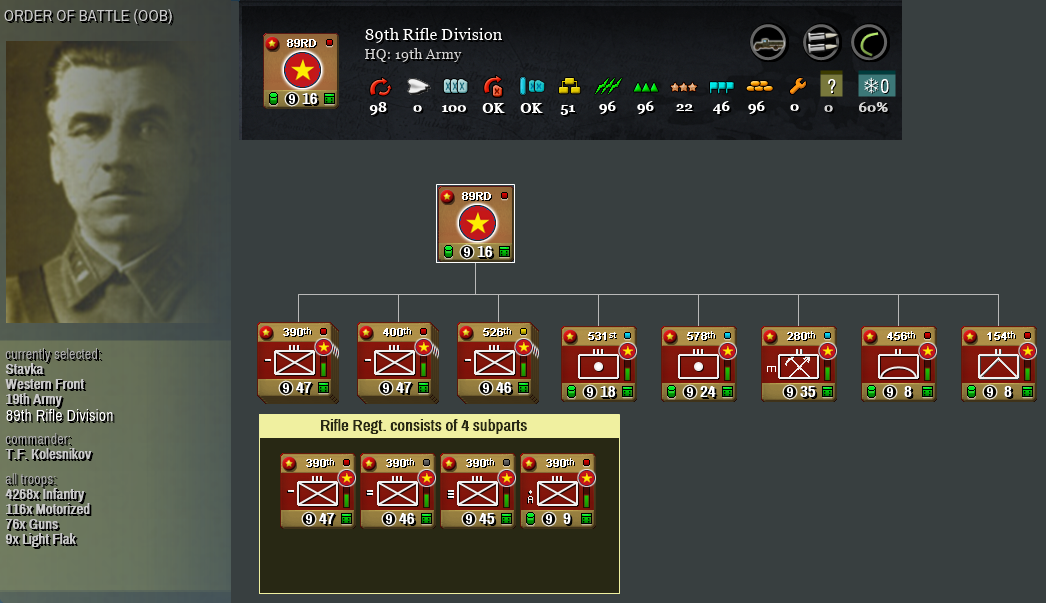
A typical full strength Soviet Rifle division consists of 17 sub-units
In practice, the catastrophe of the first months of Operation Barbarossa rendered the actual combat strength of these formations essentially a fraction of their theoretical strength. Many divisions were encircled, destroyed, and reformed on an extraordinary scale. Subsequent reorganizations merely reflected attempts to formalize the men and equipment actually available for the new formations or replenish the depleted rifle divisions. The July 1941 Rifle Division officially numbered 10.225 men and 465 officers with 54 50mm, 18 82mm and 6 120mm mortars plus 18 45mm AT guns. The only positive note was that many former commanders were released from the gulags and resumed their duties.
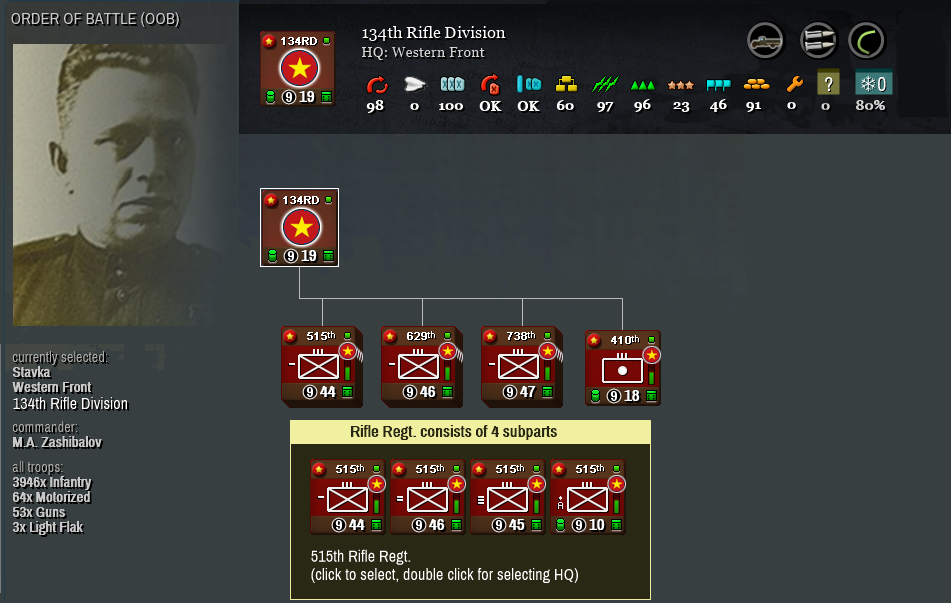
A typical Soviet Rifle division reforming in rear area consist of 13 or less sub-units
The German Infanterie Division
The infantry formed the backbone of the Operation Barbarossa German Order of Battle, advancing behind the fast- moving Panzer and motorized spearheads to secure flanks and mop-up encircled Soviet forces. The old Divisions of the 1st Welle (wave) were stronger than the new wartime divisions. (numbered 1-46). A standard 1940 1st Welle German infantry division consisted of 14.397 men plus 534 officers and 2.701 NCOs, equipped with 93 50mm and 54 81mm mortars plus 75 37mm AT guns, organized into three infantry regiments, an artillery regiment plus anti- tank, reconnaissance and engineer (pionier) detachments.
The 2nd Welle divisions (numbered 52-79) had 12.411 men, 491 officers and 2.273 NCOs. Unlike the mobile Panzer and motorized units, standard infantry divisions relied heavily on horse-drawn transport for artillery and supplies, marching on foot an average of 20 miles per day to keep up with the immense front.
In June 1941, 114 of 151 Infanterie Divisions had also an organic "Feldersatz" (field replacement) battalion formed with new recruits, stragglers, sick or light wounded men, a real source of fast replacements.
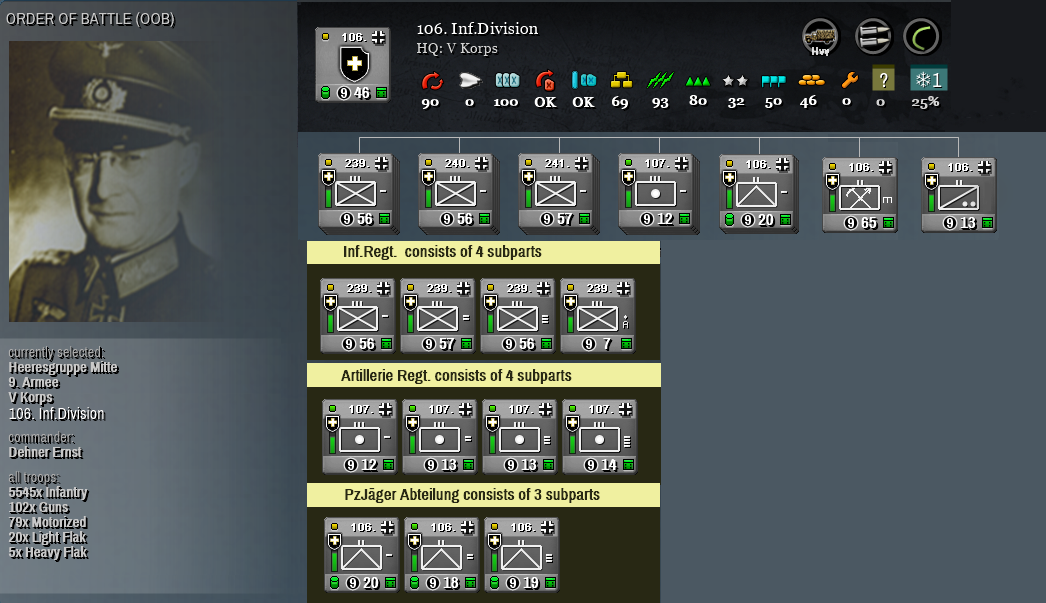
A typical full strength German infantry division consist of 21 sub-units ( plus a Feldersatz bataillon in some divisions )
The German Infanterie Division (motorized)
Germany deployed 10 motorized infantry divisions (Infanterie-Division mot.) at the start of Operation Barbarossa, (numbers 3.10.14.16.18.20.25.29.36.60.) consisted of 13.364 men plus 492 officers and 2.456 NCOs with 84 50mm, 54 81mm plus 72 37mm AT guns, though some new 50mm AT gun were delivered after the start of Barbarossa. These types of divisions worked closely with Panzer (armored) divisions to close gaps, protect flanks, and exploit breakthroughs during rapid mobile encirclements. They relied heavily on trucks and available civilian or looted transport rather than railway lines or horses, though chronic fuel shortages and poor Soviet roads put a heavy strain on these transport options.
Motorized Infanterie dvisions typically consisted of two motorized infantry regiments, an artillery regiment, an anti- tank battalion, a pionier (engineer) battalion, and a reconnaissance unit.
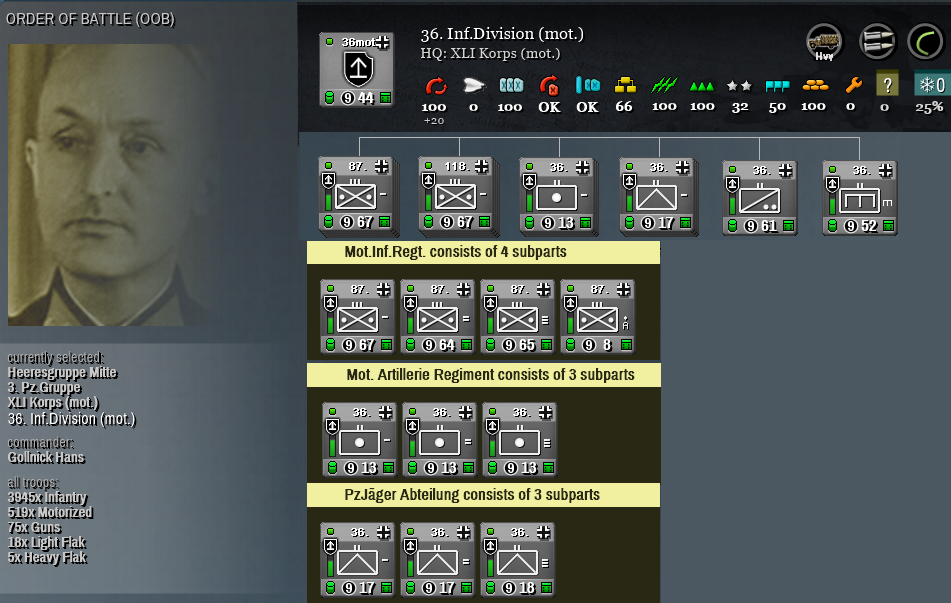
A typical full strength German motorized division consist of 16 sub-units
The German Panzer Division
In preparation for Operation Barbarossa all German Panzer Divisions lost one of the two panzer regiments and so nearly 40% of their Tanks strength to double the total number of Panzer Divisions.
In August 1940 the 11.PzD, 14.Pz.D and 16.PzD were formed, while the 13.PzD, 17.PzD, 18.Pz.D and 20.PzD followed in October 1940, and the 15.PzD and 19.PzD in November 1940 Finally the 12.PzD was formed in January 1941.
So, in June 1941 for "Barbarossa" the combat strength of the Panzer Divisions dropped from 250-300 to 150-200 Tanks. Moreover the 6.PzD had the Pz.35(t) and the 7, 8,12,19 and 20.PzD had the Pz.38(t), all with 37mm guns.
An average June 1941 Panzer Division had 9.321 men plus 394 officers and 1.962 NCOs.
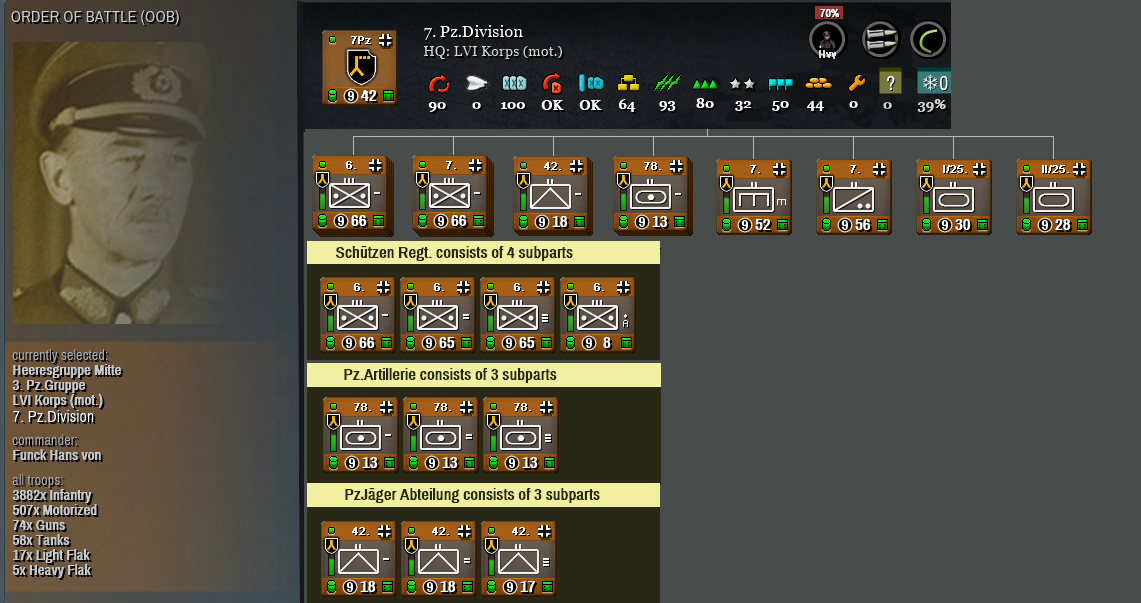
A typical full strength 1941 German panzer division consist of 18 sub-units
The SS organization
The SS units at the opening of the Barbarossa campaign were organized as motorized units:
- SS Leibstandarte, a reinforced motorized regiment of (10.796 men), attached to Army Group South.
- SS Das Reich, was a motorized infantry division ( 19.021 men), attached to Army Group Center.
- SS Totenkopf, was a motorized infantry division ( 14.606 men ), attached to Army Group North.
- SS Polizei was a motorized infantry division ( 17.000 men ) in Army Group North.
- SS Wiking was a motorized division ( 20.000 men), attached to Army Group South.
All the SS formations experienced significantly higher attrition and casualty rates than standard Wehrmacht units because they were frequently used as aggressive mobile spearheads and by late autumn 1941, units like the Leibstandarte and Das Reich were reduced to roughly 50% of their operational personnel strength due to intense combat and harsh conditions during the drive toward Moscow. As an example, on 22 October 1941 the Das Reich's 11.SS Regt. was disbanded to replenish two other regiments in the division just to maintain their combat effectiveness.

A full strength 1941 SS motorized division, the 2.SS Das Reich, consist of 23 sub-units (19 sub-units from 22 October 1941)
Wishlist the game here.