We use cookies to help give you the best possible experience on our site. Strictly necessary and functional cookies support login and shopping cart features, they cannot be disabled. Performance cookies support site performance analysis. These are optional and will be disabled if you click on Reject.
By clicking Accept you agree to our use of Performance cookies as detailed in our Privacy Policy.
Armored Brigade II - Dev Diary #10 | Audio Overhaul, Polish Rework and AI Improvements
socials
Published on April 24, 2026
Greetings Commanders,
After the successful launch of the first DLC for Armored Brigade II, Scandinavia, we are once again turning our attention to the base game and the improvements currently in development. We begin today with one of the most important parts of battlefield immersion: sound.
Audio is often one of the most overlooked aspects of game development, yet it has an enormous influence on how a game feels to play. It shapes the atmosphere, conveys impact, and gives weight to every engagement. A shell landing in the distance, the burst of an autocannon, the thunder of advancing armor: these moments are remembered as much through sound as through visuals.
The history of our game has never been that of a massive studio production assembled by dozens of specialists or supported by a proper budget. For long stretches of its existence, it was closer to a passion project, built through persistence and determination to create the kind of wargame we ourselves wanted to play. Over the years, talented people joined that journey one by one, each bringing something valuable, each helping shape the project into more than it was before.
The latest addition to the team belongs to that same tradition. Juan Antonio Camara Tuason, also known as MusicalCat, approaches sound design in a highly distinctive way, favoring original recordings and deep transformation work rather than relying on expensive stock sample libraries. He draws inspiration from the more expressive traditions of sound design associated with creators such as Ben Burtt, and from the films and games many of us grew up with in the 1990s and early 2000s.
A major part of his work relies on a proprietary method he calls "Outverb," refined over several years. This technique allows detailed control over the character of gunfire: rate of fire, tonal shape, echo, distance, and report, all built from relatively small recorded source material. Without access to weapon ranges or large recording budgets, it became an innovative and cost-effective way to produce convincing and distinctive battlefield audio at scale. The result is a substantial sound rework that strengthens the atmosphere of every engagement. And there is still much more to come.
Some of the new models and units added, including the East German FASTA-4.
Another major area of work in the incoming update has been a near-complete rework of the Polish forces, drawing on updated archival research. Throughout the existence of the Warsaw Pact, the Polish Army was the second most powerful military force in the alliance after the Soviet Army. In terms of personnel, conventional armaments, and the number of tactical formations fielded, it represented a major presence on the European continent. At higher command levels, the Polish Army broadly followed Soviet models, but at lower tactical levels, the Poles pursued their own approach, producing several distinct differences in organization, equipment, and battlefield practice.
Those differences are now modelled much more accurately in the game. Polish tank platoons, for instance, operate with four vehicles rather than the Soviet standard of three, a seemingly small distinction that has real implications for how armored formations fight and absorb casualties. The rifle platoon structure likewise followed its own logic, and the Polish order of battle included formations with no direct Soviet input: an airborne arm with its own organizational character, and a naval infantry branch shaped by Poland's Baltic responsibilities. Revisions have touched virtually every formation, and further work on the Territorial Army is expected to follow, with some extra content.
Probably never seen in any game before: the highly obscure TOSU-76. Based on obsolete SU-76 hulls, with more than 100 produced initially for the Internal Security Corps and later operated mostly by the Internal Defense Forces, it formed the early core of Polish mechanised forces. Recreating it was a challenge in itself, as only a handful of reference photographs are known to exist.
The main reason Poland's forces developed along these lines was economic reality. Warsaw Pact obligations required Poland to maintain armed forces whose size often exceeded what the national economy could comfortably sustain. This placed limits on modernization and frequently forced difficult compromises in procurement, readiness, and equipment development. This is part of what makes the Polish Army such a compelling subject: a force burdened by demands beyond national resources, yet sustained by capable personnel who treated service as a genuine duty.
We are also continuing to improve battlefield behavior through new AI stance logic. Units set to Aggressive will now move to engage enemy contacts spotted by other elements of their formation, not just targets they can see themselves. In practice, this means that when a lead element makes contact with an enemy unit, other units in the formation will begin moving to engage rather than holding position and waiting in their own line of sight. A flanking platoon mate that spots a tank company pressing through a tree line can now draw the attention of friendly units further back, allowing the formation to respond with coherence rather than in isolation. This is an ongoing but meaningful step toward cooperative tactical behavior, and it works alongside the improved ammunition selection logic introduced in the previous patch, which already gave AI units a better foundation for choosing the right response once they start engaging.
These changes are another step toward a more dynamic and authentic battlefield experience, and we look forward to showing you more as development continues. Now, back to the front!


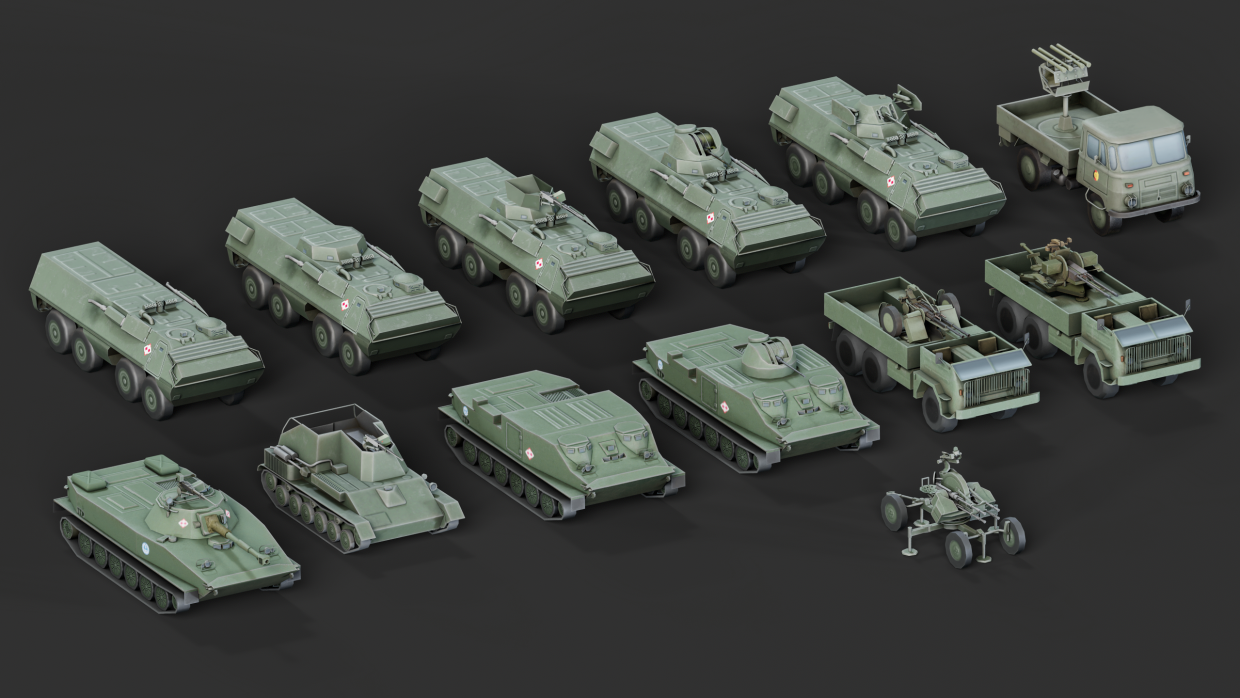 Some of the new models and units added, including the East German FASTA-4.
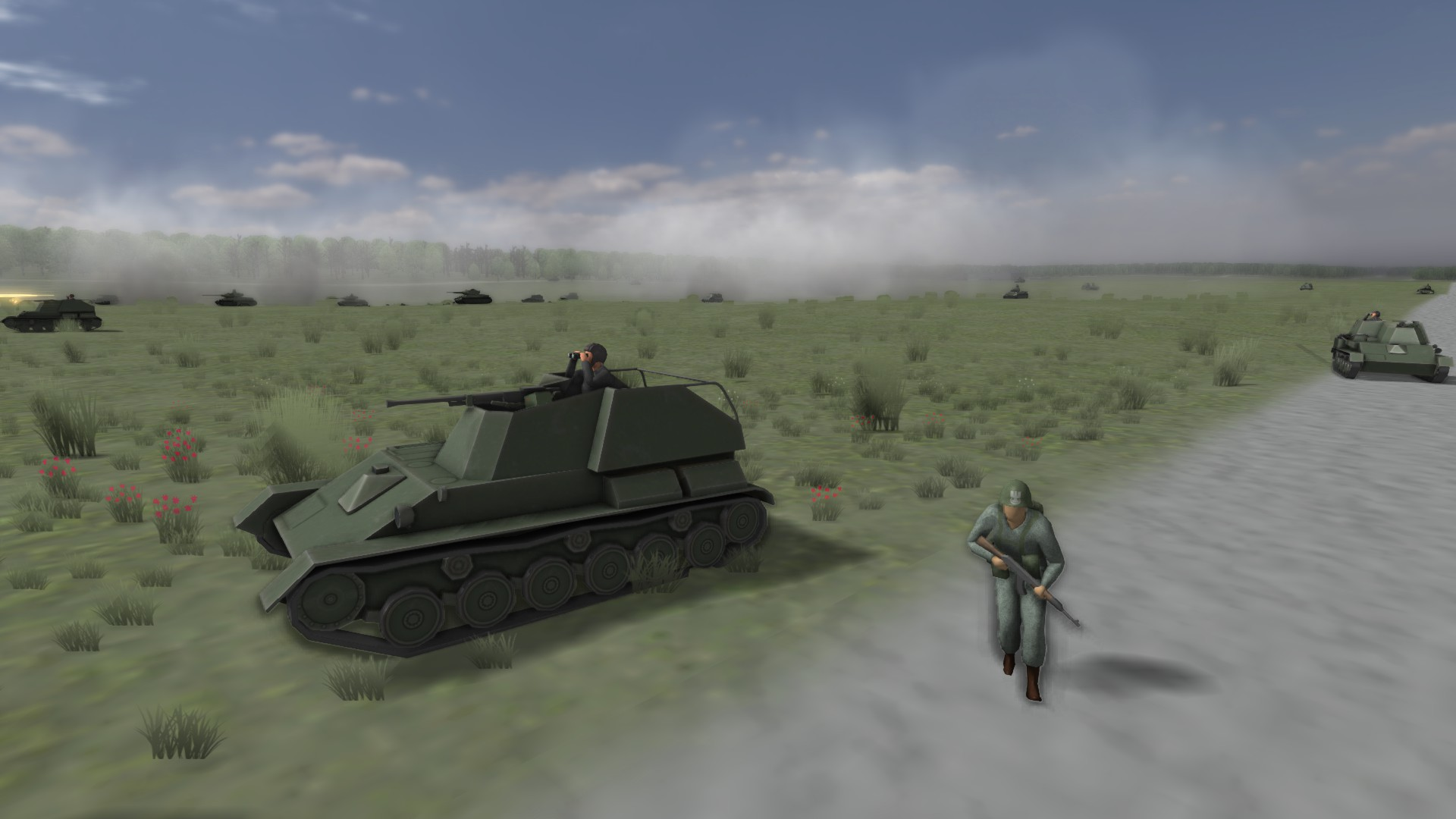 Probably never seen in any game before: the highly obscure TOSU-76. Based on obsolete SU-76 hulls, with more than 100 produced initially for the Internal Security Corps and later operated mostly by the Internal Defense Forces, it formed the early core of Polish mechanised forces. Recreating it was a challenge in itself, as only a handful of reference photographs are known to exist.